Showing posts with label Measures. Show all posts

Sunday, February 13, 2011

T-188 Days - BMI

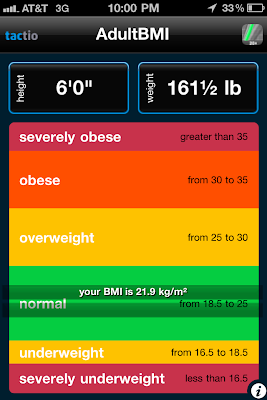
Back in October we took a measure of our BMI. As stated then, body mass index (BMI) is a measure of body fat based on height and weight that applies to adult men and women. You simply enter your weight and height using standard measures into an appropriate app or formula and out pops the result. 

The BMI score means the following:
BMI
Underweight
Below 18.5
Normal
18.5–24.9
Overweight
25.0–29.9
Obesity
30.0 and Above
My BMI in October was a healthy 22.1. http://300twentydays.blogspot.com/2010/10/t-314-days-bmi.html Several months later, using the same app, I calculated a score of 21.9. With consistent training like we've got going now, the score should continue to indicate greater degrees of leanness.

Tuesday, February 1, 2011

T-200 Days

After a weekend in the 70's, I woke up to ice and sub-zero wind chill's this morning in Dallas.  Tonight we may get into single digits on the thermometer and it's not supposed to get above freezing until maybe Friday.  So much for running outside.  I'll do some core and upper body work today and worry about the aerobic exercise when I can.

As I posted yesterday, the Asics GEL-Kayano 17 LE's I was interested in turned out to be the wrong shoe for my feet.  They are engineered to correct for over-pronatation and I require a more neutral shoe. To provide a little more context to this, Runners World has a great explanation that I'm adding below.

Pronation

From Runner's World Wiki


The body naturally dissipates shock by rolling the foot inward, or pronating, just after impact. But too much (or too little) pronation can cause injuries. While you can't change how much you pronate, you can buy shoes optimized for your biomechanics. Three ways to do this:
  • Identify your arch type by taking the "wet test."
  • Study old shoes to see how the tread has worn down.
  • Ask your specialty running shop to analyze your gait.


Underpronation

When a foot underpronates, or supinates, the foot does not roll inward enough after the outside of the heel lands. Consequently, impact forces are concentrated on the outer part of the foot. This causes more stress on the lower leg. High arches and wear along the outside edge of the shoe (image at right) are classic characteristics of an underpronator.


Normal Pronation

For most runners, the outside of the heel lands first then the rest of the foot rolls inward about 15 degrees to come into contact with the ground. This motion distributes the impact forces evenly and aligns the foot to efficiently push (or toe) off. This degree of pronation is most often associated with a normal arch and tread wear (right) on the heel and ball of the shoe.


Overpronation

Here, the foot rolls inward more than the ideal 15 degrees. As a result, the foot and ankle have problems stabilizing the body, and the impact isn't efficiently absorbed. At the end of the gait cycle, the big toe must do most of the work to push off the ground. If your shoes are worn in the heel and the inside edge (right) and you have flat arches, you're probably an overpronator.

I found the article above helpful.  Thanks Runner's World! Learn more here: http://wiki.runnersworld.com/index.php/Pronate

Sunday, October 10, 2010

Training Log - Day 2

Not a great day in Colorado but I wanted to get a weekend run under my belt.

Time of Day - Early afternoon (Cowboys kick-off)
Weather - cloudy and cool with slight sprinkle; mid-50's
Route - St. Vrain Greenway to 119th Street overpass
Distance - no idea
Pace - smow (slow to moderate)
Time - 51 minutes
iPod - Chris Tomlin
Comments - Quads very tight, knees still a little stiff, but feet felt much better in new shoes. A more difficult run mentally...not good focus.

With weight of 158 lbs and 6'0' height my Body Mass Index (BMI) is 21.5. This falls into the healthy range of 18.5 - 24.9. Of all places, I calculatd this on the AARP BMI Calculator :)

T-314 Days - BMI

National Heart Lung and Blood Institute Logo

Per their website, the body mass index (BMI) is a measure of body fat based on height and weight that applies to adult men and women.   You simply enter your weight and height using standard measures and viola! 

BMI is an estimate of body fat and a good gauge of your risk for diseases that can occur with more body fat. The higher your BMI, the higher your risk for certain diseases such as heart disease, high blood pressure, type 2 diabetes, gallstones, breathing problems, and certain cancers.
Although BMI can be used for most men and women, it does have some limits:
  • It may overestimate body fat in athletes and others who have a muscular build.
  • It may underestimate body fat in older persons and others who have lost muscle.
The BMI score means the following:
BMI
Underweight
Below 18.5
Normal
18.5–24.9
Overweight
25.0–29.9
Obesity
30.0 and Above

I caluclated mine on the iPhone app and came out with a healthy 22.1.  I'm reasonably lean, so this may be overstated (?) slightly, but it's a benchmark for me to compare to.  The measure is below.


Learn more here http://www.nhlbisupport.com/bmi/